Quote
Subtotal:
$0
Views: 0 Author: HUIHE Editorial Team Publish Time: 2025-11-25 Origin: HUIHE PACK
When comparing a 700ml liquor bottle with a 500ml liquor bottle, the main difference is capacity. A 700ml bottle holds 200ml more liquid, while a 500ml bottle offers a smaller format for selected products and markets. For spirits brands and distilleries, bottle size can affect product positioning, packaging costs, shipping efficiency, and compliance with local market requirements. Understanding these factors helps buyers select a bottle size that fits their product and target market.
700ml bottles hold 200ml more than 500ml bottles and are commonly used for spirits in markets such as the European Union.
500ml bottles offer a smaller format that may suit selected markets, specialty products, and particular packaging strategies.
Compare cost per milliliter when evaluating retail prices, but remember that the larger bottle does not always offer better value.
Check local requirements before choosing a bottle size for export, as permitted and commonly used sizes vary by market.
For spirits brands, the right bottle size depends on target market, product positioning, packaging costs, and filling requirements.
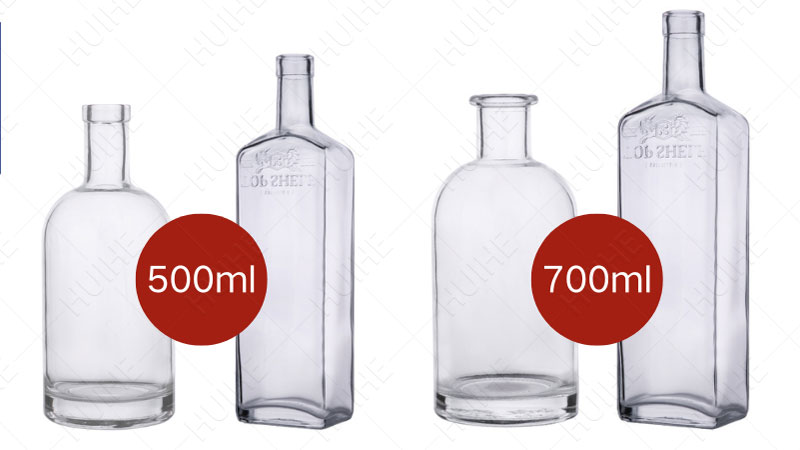
When you compare liquor bottle sizes, the difference between a 700ml and a 500ml liquor bottle stands out. You get more liquor with the 700ml size, which can make a big impact on your experience and your budget. If you want to see the exact difference, check out this table:
Description |
Value |
|---|---|
Volume of 700ml bottle |
|
Volume of 500ml bottle |
|
Volume Difference |
|
Percentage Difference |
28.57% |
A 700ml liquor bottle holds 200ml more than a 500ml bottle, representing 40% more liquid relative to the smaller size. A 500ml bottle contains approximately 28.6% less liquid than a 700ml bottle.
Both sizes are used for spirits, but their suitability depends on the target market, product category, and intended use. For brands and distilleries, bottle capacity should be selected based on market requirements and product positioning rather than assuming one size is always better.
Bottle Size |
Common Usage |
Consumer Perception |
|---|---|---|
500 ml |
Personal use, gifting |
Less common, limited appeal in U.S. |
700 ml |
Standard for gatherings |
Familiar choice, better value |
Servings Per Liquor Bottle
The number of servings in a liquor bottle depends on the amount poured per serving. Using a 1.5 US fluid ounce serving, approximately 44.4ml, the following table provides an estimate for common bottle sizes.
| Bottle Size | Approximate Number of Servings |
|---|---|
| 500ml | 11 |
| 700ml | 15 |
| 750ml | 17 |
| 1L | 22 |
| 1.75L | 39 |
These figures are estimates based on the stated serving size. Actual servings vary depending on the amount poured and any liquid left in the bottle.
For spirits brands, offering different bottle capacities may help meet the needs of different markets and product ranges. The appropriate sizes depend on local requirements, customer demand, and product positioning.
Tip: If you're a brand or a distiller, offering different sizes of liquor bottles can help you reach more customers. Some people want a small bottle for sampling, while others prefer a larger bottle for sharing.
You can find liquor bottle sizes for every occasion. Whether you want a 500ml bottle for a quiet night or a 700ml bottle for a party, you have plenty of choices. The right liquor bottle size makes a difference in value, convenience, and enjoyment.

The total retail price of a 700ml bottle is generally higher than that of a 500ml bottle when comparing otherwise similar products. However, the price per milliliter may be lower for the larger bottle.
For example, consider these illustrative prices, which are not market averages:
| Bottle Size | Example Price | Price per ml |
|---|---|---|
| 500ml | $15 | $0.030 |
| 700ml | $20 | $0.0286 |
In this example, the 700ml bottle costs more overall but less per milliliter. Actual prices vary depending on the spirit, brand, taxes, retailer, and market.
For packaging buyers, bottle size is only one factor affecting total cost. Glass weight, bottle dimensions, closures, decoration, and shipping configuration should also be considered.
Tip: Compare the complete product and packaging costs rather than judging value by bottle capacity alone.
When comparing 500ml and 700ml liquor bottles, consider the total price, cost per milliliter, storage requirements, and intended market.
A 700ml bottle provides more liquid per bottle and may offer a lower cost per milliliter in some cases. A 500ml bottle offers a smaller capacity that may fit particular product ranges or market preferences.
For spirits brands, the decision should also account for packaging costs, filling requirements, and local regulations. The most suitable bottle size is the one that meets the product's commercial and packaging requirements.

A 700ml liquor bottle is a common spirits format in markets such as the European Union. For brands and distilleries, it may be suitable for standard product lines when the capacity meets local requirements and market expectations.
When selecting a 700ml glass bottle, consider its shape, dimensions, closure compatibility, and decoration options alongside the capacity. These details affect how the bottle fits your product positioning and packaging requirements.
A 500ml liquor bottle provides a smaller capacity than a 700ml bottle. Depending on the target market and product strategy, it may suit specialty spirits, limited-edition products, gift sets, or markets where this size is commonly used.
For distilleries and spirits brands, the choice should depend on customer demand, local requirements, and product positioning. Bottle shape, closure, and decoration can then be selected to match the intended packaging design.
No matter which size you choose, you can find a liquor bottle that matches your needs. Think about how much liquor you want, the type of event, and your brand goals. HUIHE offers a wide range of bottle sizes and can help you design the perfect bottle for any serving or occasion.

Liquor bottle sizes vary by country and product category. The 700ml format is common for spirits in the European Union, while 750ml, 1L, and 1.75L are familiar formats in the United States. Other capacities, including 500ml and 720ml, are also used in particular markets and product categories.
Market preferences should not be treated as universal rules. For spirits brands, selecting a bottle size requires considering local regulations, established retail formats, distribution needs, and customer demand.
If you are developing packaging for multiple markets, confirm the intended destinations before finalizing bottle specifications.
Before choosing a liquor bottle size, verify the packaging requirements in the destination market. Permitted nominal quantities can vary by country and product category.
For example, 700ml is a common spirits bottle size in the European Union, while 750ml, 1L, and 1.75L are common formats in the United States. The United States also permits additional sizes, including 700ml.
These examples are not a complete statement of the law. Regulations may change and may distinguish between product categories. Brands should confirm the applicable requirements for their specific product and market before production or export.

The advantages of 500ml and 700ml liquor bottles depend on the intended market and product requirements.
| Factor | 500ml Bottle | 700ml Bottle |
|---|---|---|
| Capacity | Smaller volume | Holds 200ml more |
| Total price | May be lower for comparable products | May be higher for comparable products |
| Price per ml | May be higher | May be lower |
| Storage | Depends on bottle dimensions | Depends on bottle dimensions |
| Market suitability | Depends on local demand and regulations | Common in some spirits markets |
| Product positioning | May suit selected specialty ranges | May suit standard product lines in relevant markets |
Neither size is automatically the better choice. Consider market requirements, packaging costs, bottle design, and intended product positioning before making a decision.
Choosing between a 700ml and 500ml liquor bottle depends on your target market, product positioning, packaging costs, and applicable regulations. A 700ml bottle holds 200ml more liquid, while a 500ml bottle offers a smaller capacity that may suit particular products and markets.
For spirits brands and distilleries, bottle capacity should be considered alongside bottle shape, closure compatibility, decoration, and filling requirements.
If you are sourcing glass liquor bottles, contact our team to discuss suitable sizes, available designs, and customization options for your project.

Consider your target market, product positioning, packaging costs, and local requirements. A 700ml bottle holds 200ml more liquid, while a 500ml bottle offers a smaller capacity.
A 500ml bottle may be used for different spirits, provided the bottle and nominal quantity meet the applicable requirements for the product and destination market.
Bottle sizes reflect local regulations, market conventions, product categories, and customer demand. Brands should verify requirements for each target market before selecting a bottle size.
Bottle capacity alone does not determine the taste of the spirit. Flavor is influenced by the spirit itself, production methods, and storage conditions.
Customization options depend on the bottle design and production requirements. Available options may include different shapes, glass appearances, closures, and decoration methods. Confirm availability and specifications with your supplier before ordering.