Quote
Subtotal: $0

Views: 42 Author: HUIHE Editorial Team Publish Time: 2026-07-22 Origin: HUIHE PACK


Large format spirits bottles are not scaled-up versions of a standard 750mL. The glass engineering requirements change above one litre, the container economics work differently, the available stock molds are far more limited, and the compliance picture — particularly for the US market — has specific constraints that catch buyers off guard when they assume large format follows the same approval logic as standard sizes. Procurement teams that approach a 1.75L or 3L order with the same brief they use for standard sourcing consistently encounter surprises at the sample stage or, worse, at customs clearance.
The large format category covers several distinct commercial contexts: the 1L standard in EU retail and travel retail; the 1.75L ("handle" or "half-gallon") dominant in the US value and club-store channel; and 3L formats used primarily for display, prestige, and gifting. Each has different glass engineering requirements, different market access rules, and different container economics. At HUIHE, we supply large format spirits glass bottles to brand procurement teams shipping to EU, US, Middle East, and Asia-Pacific markets, and the sourcing questions in this format category are consistently more complex than those that arise at standard sizes.
This guide covers the structural, compliance, and logistics dimensions that distinguish large format B2B procurement from standard bottle sourcing. For the broader context of sourcing spirits glass from a Chinese manufacturer — including the sampling process, mold development timeline, and quotation evaluation — our guide on how to source custom spirits glass bottles from China covers the full procurement workflow.
Table of Contents
The commercially significant large format sizes are 1L (33.8 fl oz), 1.75L (59.2 fl oz, known as a "handle" or "half-gallon" in the US), and 3L. The 1L is the standard large format in EU retail and travel retail. The 1.75L is the dominant large format in the US value and club-store channel. The 3L is used primarily for prestige display, gifting, and HoReCa bottle service, with more limited market access due to regulatory approved-size requirements.
In the US, the TTB publishes an approved list of bottle sizes for distilled spirits. The 1L and 1.75L are both approved for US retail sale. The 3L is not on the TTB's approved list and cannot be sold commercially in the US retail or on-premise channel. EU approved sizes for spirits include 1L and 1.75L among others; rules for 3L vary by product category and destination country. Always verify your target size against the current approved list for each market before committing to a mold or production run.
Glass weight does not scale linearly with volume. A 1.75L bottle requires disproportionately more glass than a 750mL because the structural engineering requirements change: thicker walls, a heavier base, and stronger neck construction are needed to handle the greater liquid weight during filling, handling, and distribution. This additional glass adds raw material cost, increases furnace energy consumption, and may require dedicated mold tooling that amortises across a smaller production universe than standard sizes. Per-litre cost is therefore higher at large format, not lower.
A 1.75L spirits bottle should weigh a minimum of 650–750g for standard commercial distribution. Premium or decorative 1.75L bottles often run 800–950g. The minimum is determined by the bottle's height-to-diameter ratio, base thickness, and mechanical stress expected during filling and palletised transit. Accepting a 1.75L bottle that uses weight specifications intended for a 1L — a common outcome in low-cost sourcing — produces unacceptable breakage rates in distribution.
No. A 750mL mold design cannot be proportionally scaled and applied to a 1.75L specification. The dimensions, wall profiles, base construction, and neck geometry all require independent engineering for the larger volume. Some suppliers will produce a "scaled" version of an existing design without re-engineering it — this is a significant quality and safety red flag. Any large format custom mold requires a clean specification with glass thickness and weight targets verified independently before tooling is cut.
Standard B2B spirits bottle sourcing works efficiently at 750mL because the category is well-established. Factories maintain large stock ranges, mold options are plentiful, compliance approvals are routine, and buyers have accumulated working knowledge of what to expect. Large format procurement operates in a materially different environment on every one of these dimensions.
Stock mold availability drops significantly above 1L. A factory carrying 80–100 stock mold options at 750mL may carry fewer than 10 at 1.75L, and often none at 3L. This means large format sourcing almost always involves either accepting a limited stock option or committing to custom mold development — with the associated tooling cost and extended lead time. The brief therefore needs to be more detailed at large format, not less, because the factory has fewer defaults to fall back on and every specification that is left unconfirmed becomes a factory decision made without the buyer's positioning intent.
The compliance risk is also elevated. Buyers who have navigated standard approval processes for 750mL and assume the same logic applies to 3L discover — typically after the production run — that the 3L is not on the US approved size list. That is a late and expensive discovery. Compliance verification for large format must happen before the brief is finalised, not after the mold is cut and the deposit is paid.
Format | Volume | Primary Markets | Typical Channel | US Retail Approved | Notes |
|---|---|---|---|---|---|
1L | 1,000mL / 33.8 fl oz | EU, UK, Travel Retail, Middle East, APAC | Retail, duty-free, HoReCa | Yes | Standard large format in most non-US markets; widest stock mold availability at this scale |
1.14L | 1,140mL / 38 fl oz | UK (historically), Canada | Retail (declining) | No | Legacy UK quart size; largely replaced by 1L; limited ongoing demand |
1.5L | 1,500mL / 50.7 fl oz | EU (select markets), gifting | Gifting, duty-free | No | Less common; verify EU approved-size list for destination market before ordering |
1.75L | 1,750mL / 59.2 fl oz | USA (dominant), Canada | Club stores, value retail, bar supply | Yes | The US "handle"; highest-volume large format globally; limited stock molds available |
3L | 3,000mL / 101.4 fl oz | EU, Middle East, Travel Retail, APAC | Prestige gifting, HoReCa display, bottle service | No | Not approved for US retail; almost always requires custom mold; significant tooling investment |
4.5L / 6L | 4,500mL+ | EU (ultra-premium), Travel Retail | Collector display, ultra-premium gifting | No | Custom engineering required; very limited production capacity; long lead time |


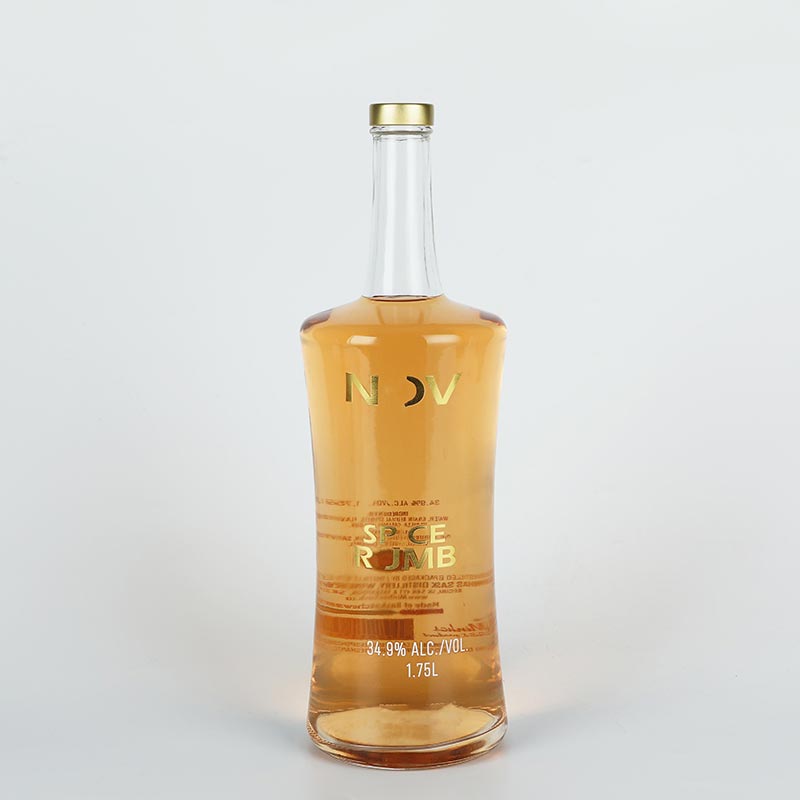


A common assumption — and a common source of sourcing problems — is that a 1.75L bottle should weigh roughly 2.3 times a comparable 750mL (1,750 ÷ 750 ≈ 2.33). In practice, the ratio is lower. A standard 750mL spirits bottle in a mid-range specification weighs approximately 450–550g. A properly engineered 1.75L in a comparable specification weighs 650–800g — a ratio closer to 1.4–1.6, not 2.3.
This reflects a fundamental engineering reality: as bottles get taller and heavier when filled, the structural demands shift. The base must carry more static load; the lower panels must resist more internal pressure; the neck must handle mechanical stress from filling equipment operating at the torque requirements for a heavier bottle. Glass weight is not distributed proportionally to volume — it is distributed according to the structural requirements of each section.
The implication for buyers is that a supplier who quotes a 1.75L at a price that implies the same per-litre glass cost as their 750mL has reduced the glass weight to make the economics work. This is the most common quality failure mode in low-cost large format sourcing, and it is detectable only if you ask for the glass weight specification before agreeing to sample.
Minimum glass weight in grams: State the target explicitly in the brief. For a 1.75L in standard commercial distribution, 650g is a floor; 750g+ is appropriate for club-store channels where mechanical handling is intensive.
Base thickness: The base must be engineered for large format load, not scaled from a smaller mold. For a 1.75L, centre-base thickness should be confirmed at the pre-production sample stage.
Wall profile at mid-panel: Confirm minimum wall thickness at the widest panel point, particularly for bottles distributed in stacked or mechanically-handled retail environments.
Height-to-diameter ratio: Taller, narrower bottles are more vulnerable to toppling on filling lines. Confirm that the bottle's H:D ratio is compatible with your filling equipment configuration before the mold is cut.
Neck and finish construction: The neck must handle the torque and lever arm load of closures applied to a heavier bottle during pouring. Neck construction is a common failure point in under-specified large format sourcing.
For any large format order, request the following before approving production: glass weight in grams (not a range — a specific target); wall thickness at base, mid-panel, and shoulder; base thickness at centre; and any internal testing data on impact resistance at the specified weight. A factory that cannot provide this data is not positioned to have a meaningful specification conversation about large format glass.
Bottle size compliance is the most operationally dangerous element of large format spirits sourcing because it is the one error that cannot be corrected after production. A non-approved size in the target market means the bottles cannot be sold in that channel — not a quality defect that can be negotiated, but a regulatory issue that makes the shipment unusable.
The TTB publishes an approved list of bottle sizes for distilled spirits sold commercially in the US. The 1L and 1.75L are on this list and approved for retail sale. The 3L is not on the approved list and cannot be sold in US retail or commercial on-premise channels. Any spirits bottle size not on the approved list requires a variance application to the TTB, which is rarely granted for standard commercial purposes.
This creates a clear rule for US-market procurement: if the target size is 1L or 1.75L, you are on approved ground. If the target size is 3L or anything not on the published list, it cannot be sold through standard US retail or on-premise channels. Confirm this in writing with your supplier before the brief is finalised — not as a post-production check.
EU packaging quantity regulations for spirits fall under Directive 2007/45/EC and its implementing provisions. Approved sizes include 100mL, 200mL, 350mL, 500mL, 700mL, 1L, 1.5L, 1.75L, and 2L, among others. Larger formats including 3L may be permissible in specific product categories or uses — verify the applicable framework for your product type and destination country before committing to a non-standard size. The UK retained the same approved-size framework post-Brexit; no material divergence has been introduced for spirits as of 2026.
For the complete compliance framework covering US and EU spirits export requirements — including labelling, COLA applications, and alcohol content declarations — our article on spirits bottle export compliance for the US and EU covers the full regulatory picture in detail.
Container economics for large format spirits bottles differ significantly from standard 750mL sourcing. Large format bottles have a larger physical footprint per case, higher weight per unit, and pack out at lower bottle counts per case. The combination means fewer bottles per container than buyers used to 750mL economics expect — and a higher per-unit freight cost that must be factored into total landed cost before the order is placed.
Format | Typical Bottles per Case | Approximate Cases per Pallet | Approximate Bottles per 40ft Container | Approximate Gross Weight per Pallet |
|---|---|---|---|---|
750mL (reference) | 12 | 50–60 | 14,000–16,000 | 550–700kg |
1L | 12 | 40–48 | 9,500–12,000 | 700–850kg |
1.75L | 6 | 28–36 | 4,500–6,500 | 750–900kg |
3L | 4–6 | 16–24 | 2,000–3,500 | 700–900kg |
These figures are indicative ranges based on standard pallet dimensions (1,200 × 1,000mm) and a 40ft standard container (approximately 67 cubic metres usable). Actual figures vary by bottle dimensions, case outer size, stacking height, and whether cube or weight limits the load first. For most 1.75L orders in standard 6-bottle cases, the cube constraint is reached before the weight limit. The practical implication: a 1.75L order filling a 40ft container holds approximately 5,000–6,500 bottles, versus 14,000–16,000 for 750mL. This affects per-unit freight cost substantially.
For a detailed framework on calculating the impact of glass format and weight on per-unit shipping cost — including container loading optimisation and the trade-off between glass weight and freight economics — our guide on spirits bottle weight and shipping cost optimisation covers the full methodology.
A large format brief requires more precision than a standard 750mL brief. The margin for error is higher — tooling investment is larger and stock alternatives are fewer — and the engineering decisions are less standardised. The following should be confirmed as hard specifications in any large format brief, not left as preferences for the factory to interpret:
Target volume and fill line: Nominal capacity in mL, plus fill line height measured from base — both are needed for filling equipment calibration and label placement on taller bottles
Minimum glass weight in grams: State a specific number; do not accept a factory default for large format production
Base and wall thickness requirements: For club-store or high-velocity distribution channels, specify minimum acceptable thickness at base centre and mid-panel
Closure type and application torque compatibility: Large format closures must be specified with the filling line's application torque in mind; a loosely-specified closure on a 1.75L is a distribution liability
Decoration coverage and process: Confirm that your chosen decoration process is available on the factory's large format production line — some factories run ACL and other finishes only on standard-size equipment
Compliance confirmation in writing: Confirm that the target size is on the approved list for your destination market; include this as a line item in the supplier confirmation before tooling proceeds
MOQ for this format specifically: Confirm large format MOQ separately from 750mL; do not assume parity
When you receive a quotation against a large format brief, the same evaluation rigour applies as for any B2B glass order — but with additional attention to whether the quoted glass weight is realistic for the size and whether the lead time trigger is clearly defined. For a line-by-line breakdown of what a professional glass bottle quotation should contain, our guide on glass bottle quotation price breakdowns covers each element and what should prompt further questions.
If a supplier quotes a 1.75L at a price implying the same or lower per-litre cost compared to their 750mL offering, the glass weight has been reduced to make the economics work. Glass engineering at large format costs more per litre, not less. A price that seems too competitive should prompt an immediate request for the glass weight specification before sampling proceeds.
A factory with genuine large format experience can provide glass weight, wall thickness, and base thickness data for any mold in its production range, either from existing production records or from the mold drawing. A factory that responds to these questions with generic quality assurances rather than specific numbers is not positioned to manage a large format specification to the level a commercial procurement requires.
Some suppliers will propose scaling an existing 750mL design proportionally to 1.75L as a lower-cost alternative to genuine mold development. This bypasses the independent engineering that large format dimensions require. The result is typically insufficient base or wall thickness at the larger volume. Custom large format molds require re-engineering from a clean specification, not proportional scaling.
Some suppliers will accept a 3L brief for a US-market order without flagging the approved-size issue. The regulatory risk sits with the importer of record, not the manufacturer. Any large format order for the US market should include explicit written confirmation from both parties that the bottle size is TTB-approved before any tooling cost or deposit is committed.
ACL ceramic screen printing and other decoration processes that run routinely on 750mL may have dimensional or line-speed constraints at 1.75L. Some factories run large format on separate equipment with different — or no — in-house decoration capability. If decoration is part of your brief, confirm whether the factory runs your required process on its large format line, not just on its standard-size production.
MOQ for large format spirits bottles is typically higher in unit terms than for 750mL. Machine cycle times are longer, furnace commitment per run is similar, and setup costs amortise across fewer bottles due to the larger physical size. Many factories that offer 750mL at 3,000–5,000 units MOQ require 5,000–10,000 units for 1.75L production — and some require more. Confirm MOQ for each format separately in the RFQ. Do not assume parity across sizes, and do not assume that combined 750mL and 1.75L volume earns a blended MOQ concession without asking explicitly.
The calculation requires four inputs: outer case dimensions (length × width × height), gross weight per case including packaging, usable container internal volume (approximately 67 cubic metres for a standard 40ft), and the container's payload capacity (approximately 26,000–27,000kg gross, minus the tare weight of the container itself). For most 1.75L spirits orders packed in standard 6-bottle outer cases, the volume constraint is reached before the weight limit — which means optimisation focuses on case stacking efficiency and pallet configuration. Request the outer case dimensions and confirmed gross case weight from your supplier, then work with your freight forwarder to model the loading plan before booking the container.
A COLA application for a 1.75L spirits product is a label approval process, not a bottle size approval — the 1.75L size itself is already on the TTB's approved list, so the bottle cannot be the source of rejection. COLA rejections for large format bottles typically relate to label content: the net contents declaration must be in the correct fl oz for the format, the alcohol content statement must meet the requirements for the stated class, and the mandatory health warning must meet current size and placement specifications. These are label artwork issues, correctable by revising and resubmitting. The glass bottle itself does not need to change if the size is TTB-approved.
Stock mold options for 1.75L spirits bottles exist, but the range is far narrower than at 750mL. Most factories with serious large format capability maintain 5–15 stock mold options at 1.75L, versus 50–100+ at 750mL. Available stock options tend toward a small number of established commercial profiles — cylindrical, squared-panel, and fluted forms that work across whiskey, vodka, and rum categories. If your brand's visual requirements can be met within available stock, a stock mold route significantly reduces lead time and eliminates tooling investment. If exclusivity or a specific silhouette is required, custom mold development is necessary and should be factored into the project timeline from the outset.
Most buyers reach us having treated large format as a straightforward extension of their 750mL brief: the same weight assumptions, the same compliance approach, the same container economics applied at a bigger size. It is not. The glass engineering requirements change above one litre, the compliance picture is size-specific, and the container economics need to be calculated independently for each large format SKU before the order makes commercial sense.
When we take on a large format inquiry at HUIHE, we confirm glass weight specification against the structural requirements for your specific size before quoting; we verify approved-size compliance for your target market before discussing mold options; and we walk through container loading economics so your freight cost assumptions are grounded in the actual pallet configuration for your bottles. If those conversations have not yet happened with your current or prospective supplier, they should happen before you commit to tooling.
Send us your large format brief — format size, target market, decoration requirements, and order volume — at our inquiry page or directly to max@huihepackaging.com.